
Building a Home Meditation Space (Even If You Live With Kids, Roommates, or Chaos)

One of the most common questions beginners ask is: “Where am I actually supposed to meditate? My house is loud, I don’t have a spare room, and people are always walking in.”
Here’s the good news: you don’t need a perfect, minimalist Zen den to have a meaningful meditation practice. You just need a consistent corner, a few small cues that tell your nervous system “this is our calm space,” and realistic expectations for your season of life.
In our Intro to Meditation & Mindfulness workshop on May 30, we’ll talk about how to integrate your practice into your actual home and routine—not some fantasy version where you have an extra room and never get interrupted. This post will give you a head start with ideas you can implement right away, even if you’re surrounded by kids, roommates, pets, or a very opinionated dishwasher.
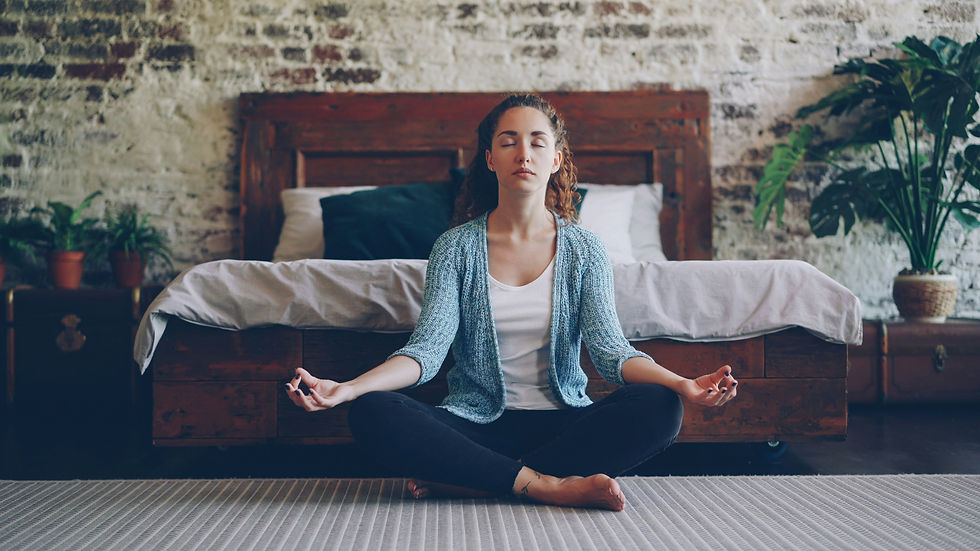
What Your Nervous System Needs From Your Space (It’s Less Than You Think)
When we talk about “creating a meditation space,” it’s easy to get lost in aesthetics: plants, crystals, candles, beautiful cushions. Those can be lovely, but your nervous system is actually asking for a few very simple things.
Here are the basics it needs:
A feeling of relative safety. Not perfection—just somewhere you’re not constantly bracing to be interrupted or judged. That might be a bedroom corner, a parked car, or a spot on the back patio where you can exhale a little.
Enough physical comfort that your body isn’t screaming at you. You do not need fancy cushions or a special bench. A regular chair, couch, or stack of pillows is more than enough, as long as your body feels supported and you’re not in pain the whole time.
One or two sensory cues that say “we’re landing now.” This could be a soft blanket, a candle, a houseplant, a favorite mug, a particular playlist, or even a certain pair of cozy socks. Over time, your body associates those cues with “oh, this is the part where we slow down.”
If you live with kids or roommates, “relative” safety and quiet is enough. Headphones plus a closed door for 5–10 minutes can be plenty for your nervous system to start shifting into rest‑and‑digest mode. You’re not trying to recreate a monastery—you’re creating a small, repeatable pocket of calm in the life you actually have.
Simple Home “Meditation Nooks” for Different Living Situations
Let’s make this concrete. Here are a few examples of how a meditation nook can look in different kinds of homes.
If You Have a Bedroom to Yourself
Choose one corner as your go‑to spot. It might be by a window, near your bed, or even at the foot of it.
Add a pillow or folded blanket to sit on, plus another blanket if that makes you feel cozy and grounded.
If you’d like, include a small table or shelf with a candle, plant, photo, or object that feels meaningful to you.
Keep your journal or workshop workbook there, along with a pen and maybe headphones. The fewer steps between you and starting, the better.
This doesn’t have to be Insta‑worthy. The goal is ease: when you walk into the room, you know exactly where to go and what to grab.
If You Share a Space / Live With Kids
Pick one chair or spot on the couch that becomes your meditation seat. Even if the living room is a shared space, using the same spot consistently helps your body recognize, “Oh, we’re doing the calm thing now.”
Create a simple boundary script with your family or roommates, such as:“When I have headphones on and this blanket over my legs, I’m in my 10‑minute meditation. Unless it’s urgent, please wait until I’m done.”It might take a few tries, but people usually adapt when they understand what you’re doing and for how long.
Consider a car‑based practice:
5–10 minutes sitting in your parked car before you go inside.
Seat reclined slightly, phone on Do Not Disturb, a short guided practice or timer.For many parents and caregivers, this ends up being the most realistic “room of one’s own.”
You can also involve kids by letting them have their own “quiet minute” nearby with coloring or deep breaths, so it feels like a family ritual rather than something mysterious you disappear for.
If Your Schedule Is Unpredictable
Shift from clock‑based expectations to routine‑based anchors.
Instead of “I meditate at 7:00 am,” try:
After coffee
Right before I open my laptop
Right after I get home and put my keys down
Keep your “kit” portable:
Headphones or earbuds
A small notebook or your workshop workbook
A pen and any small item that helps you feel grounded (stone, essential oil roller, etc.)
This way, whether you’re at home, at the studio, or on the road, you have everything you need to create a 5–10 minute meditation nook wherever you land.
Turning Your Practice Into a Tiny Ritual
Once you have a space (or a mobile “kit”), the next step is turning meditation from a vague intention into a tiny ritual. Ritual makes it feel meaningful and helps your nervous system recognize, “This is the part where we slow down now.”
You don’t need anything elaborate. Try this:
Pick a start cue.
Lighting a candle
Taking one conscious deep breath
Opening your notebook or workbook to the same page
Pressing play on a particular song or timer
Pick an end cue.
Writing one sentence about how you feel (“Right now I feel…”)
Stretching your arms overhead and taking a final breath
Placing your hand on your heart for one breath, acknowledging yourself for showing up
Allow imperfection.Some days your meditation will be interrupted. Some days it will be short and sweet. Some days it won’t happen at all. The ritual is what you come back to, again and again, without needing it to be flawless.
In the May 30 workshop, we’ll give you specific prompts and practices you can plug straight into your home routine, plus a workbook you can keep in your meditation nook so everything is in one place. The idea is that when you sit down, you already know exactly what to do for those 5–10 minutes.
Your Permission Slip to Start Where You Are
If you’ve been waiting to set up the “perfect” space before you start meditating, consider this your permission slip to begin with what you already have. A corner, a chair, a blanket, a notebook—that’s enough.
You don’t need silence, you don’t need hours, and you definitely don’t need a whole extra room. You just need a small, repeatable way to say to your nervous system, “We’re landing here for a few minutes now.”
If you’d like support creating a practice that fits your actual home, schedule, and nervous system, join us on Saturday, May 30 from 3:30–6:30 pm PT at Dance Masters Ballroom in Agoura Hills (or online) for Intro to Meditation & Mindfulness with Queen of the Mind’s Ashlieya.
We’ll explore meditation basics, nervous system tools, and realistic routines so you leave with a practice—and a setup—that genuinely works for you, not against you.
👉 Check out all the details and register here: https://www.buildersofabetterworld.org/event-details/intro-to-meditation-and-mindfulness.




Comments